
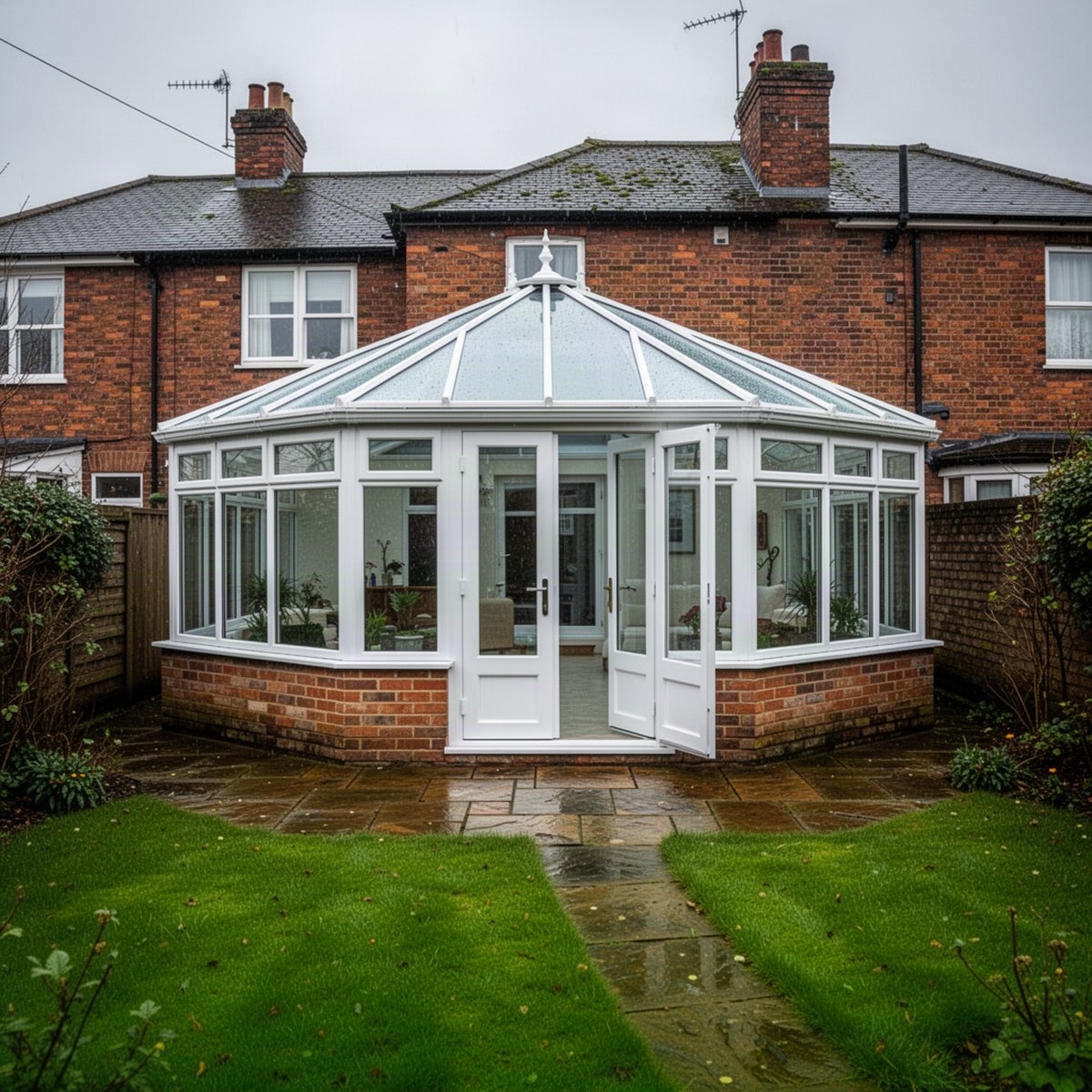
An Edwardian conservatory is square or rectangular with a flat front, while a Victorian conservatory has a rounded, faceted bay front and a steeper, more ornate roof. That choice affects usable floor space, how the conservatory suits the house, and how you price and build it.
Homeowners often know the look they like but not the name. This guide helps you steer them to the right style, and quote it with confidence.
What Is an Edwardian Conservatory?
An Edwardian conservatory has a square or rectangular floor plan, a flat front and a hipped roof that slopes back towards the house. The lines are simple and symmetrical, with far less decoration than a Victorian design.
Because every corner is a right angle, there is no wasted space. Furniture goes straight against the walls, so the room is easy to use as a dining room, snug or home office. The higher pitched roof also lets in plenty of natural light. You can see the options on our Edwardian conservatories for trade page.
What Is a Victorian Conservatory?
A Victorian conservatory has a bay shaped front made up of angled facets, usually three or five, giving a rounded, multi sided footprint. The roof is steeply pitched and follows those facets, and it is often finished with a decorative ridge, cresting and finials.
The faceted front gives a panoramic view of the garden and a more traditional, ornamental character. The trade off is that the angled sides make furniture harder to place, so a little floor space is lost compared with an Edwardian of the same size. Our Victorian conservatories for trade are made to measure for exactly this kind of project.
Edwardian vs Victorian Conservatory: The Key Differences
| Edwardian | Victorian | |
|---|---|---|
| Floor plan | Square or rectangular, flat front | Bay front with three or five facets |
| Usable floor space | Maximised, every corner usable | Slightly less, angled walls |
| Roof | Hipped roof, clean lines | Steep, multi faceted roof, often ornate ridge |
| Look | Simple, symmetrical, versatile | Ornate, traditional, rounded |
| Best suited to | Modern homes and wide plots, also many period homes | Period properties and gardens where the view matters |
Neither style is better in every case. The right one is the style that suits the house, the plot and the way the customer wants to use the room.
Which Style Suits Which Property?
This is where your advice really adds value. A few simple questions at the survey usually make the decision obvious.
What is the house like?
Victorian and Edwardian era homes, cottages and houses with bay windows tend to suit the ornate Victorian style. Modern estate houses, bungalows and new builds usually look better with the simpler Edwardian lines, although an Edwardian also sits comfortably on many period homes.
How will they use the room?
If the customer wants a dining table, sofa or desk in there, the extra usable floor space of an Edwardian makes a real difference. If the room is mainly for sitting and enjoying the garden, a Victorian’s panoramic front can be the better fit.
What does the plot allow?
On a narrow garden, a three facet Victorian can look well proportioned without dominating the space. On a wide plot, an Edwardian makes the most of the width.
“Nine times out of ten, the house tells you the answer. Stand in the garden with the customer, look at the back of the property and the decision usually makes itself.”
Scott, Director at Nova Trade Frames
Roof Options and Upgrades
Both styles can be built with a traditional glazed roof. Many homeowners now ask about tiled or solid roofs for a more year round room, so it is worth raising early, because it changes the build and the price. Be clear about what your roof system supports for each style before you quote it.
Frame colour is the other easy upgrade. White uPVC remains popular, but woodgrain and heritage colours can help a conservatory sit naturally against an older brick property. Matching the conservatory doors to the rest of the house, for example with uPVC French doors, keeps the finished job looking considered rather than bolted on.
Planning Permission and Building Regulations
Customers will almost always ask whether they need permission. The government’s Planning Portal guidance on conservatories and building regulations explains that conservatories are normally exempt from building regulations when they are built at ground level, are less than 30 square metres in floor area and are separated from the house by external quality walls, doors or windows. Glazing and any fixed electrical work still need to comply.
Planning permission is a separate question, based on size, height and position, and it can be different for listed buildings and conservation areas. Point customers to the Planning Portal or their local authority to confirm, rather than promising an answer yourself.
Building Differences Installers Should Know
From a fitting point of view, the Edwardian is usually the simpler build. Square corners make setting out the base and dwarf walls straightforward, and the roof is less complex. A Victorian needs accurate setting out of each facet angle, more shaped components and more care getting the roof lines right.
That extra work should be reflected in your quote and your programme. When you send a survey through, include the style, facet count for a Victorian, overall width and projection, dwarf wall height, door position, roof type and colours inside and out.
“Get the base right and a conservatory goes together beautifully. Most of the problems we hear about start with a base that’s out of square, and that’s even more true on a Victorian.”
Scott, Director at Nova Trade Frames
Frequently Asked Questions
Which is cheaper, an Edwardian or Victorian conservatory?
At the same size, an Edwardian is often slightly more economical to build because the shape and roof are simpler. The final price depends on size, roof type and specification, so always quote from a proper survey.
Which gives more space?
An Edwardian. Its square or rectangular shape means every corner is usable floor space.
Which is quicker to install?
Usually the Edwardian, because the square base and simpler roof take less setting out. A Victorian takes more care on the facet angles and roof, so allow for that in your programme.
Supply Your Next Conservatory with Nova
Nova Trade Frames manufactures made to measure uPVC Edwardian and Victorian conservatories for the trade, alongside our uPVC and aluminium windows and doors. With over 40 years in the industry, fast lead times and direct support from the owners, we help installers quote accurately and fit with confidence.
Browse our conservatories for trade, open a trade account or contact the team to send your next conservatory survey for pricing.